
The Shift: Payments Are Becoming Digital-Asset Native
Payment companies are moving faster than ever into stablecoins, digital assets, and tokenized money. As this shift happens, the importance of wallet and key management infrastructure becomes impossible to ignore. Every payment touches risk, compliance, uptime and trust.
Most companies start their journey with a SaaS wallet as an infra. It is easy, fast and usually gets the job done. But as they grow, many discover limits that slow them down or bring new risks they cannot control. That is usually when self-hosted MPC enters the picture.
Sodot was built specifically to give payment companies full control and independence without sacrificing performance. So why are payment companies rethinking their approach? We hear this from almost every payment team we talk to:
“[SaaS wallet provider] was great, until we outgrew it".
We keep seeing the same thing in conversations with payment teams. They start with a SaaS wallet provider because it seems like the obvious choice… until it isn’t.
The Problem With SaaS Wallet as Infra
SaaS wallets are often great when you are early, even as infra. They give you quick onboarding, easy integrations and the vendor manages most of the heavy lifting. Truth be told, no one wants to own more infrastructure. However, there are reasons why eventually some companies consider a different model.

1. Lack of control kills your edge
You depend on a vendor for uptime, feature decisions, availability of new assets, and even basic signing operations. If your wallet provider is down, you are down. If they delay support for an asset you need, you wait. If their infrastructure has an incident, you absorb the blast radius. One team told us they spent months waiting on a SaaS provider to add support for a chain they needed.
“We had a commercial deal fall apart at the last minute because [SaaS wallet provider] didn’t support the chain our partner needed. The tech was there, the appetite was there, the economics were there, but we simply couldn’t move. That’s when we realized our infrastructure was making decisions for us, instead of the other way around.”
We see this pattern often. Payment companies want to support more chains, but their wallet provider becomes the bottleneck. Some end up using hot wallets or even consumer-grade retail wallets for complex enterprise flows - not because they want to, but because they have no other option. At that point, the limitation isn’t just a pain point - it’s a revenue blocker.
Their hands were tied. That moment pushed them toward self-hosted MPC.
2. Limited visibility into your own UX
As you scale to millions of transactions, you need deep visibility into every part of your stack. You, and your customers, want to understand how keys are managed. You want to fine-tune policies. You want to build custom ops flows. A SaaS platform often hides these layers.
3. Privacy and data residency concerns
Your key operations live inside someone else’s environment. For a regulated payment company, this creates questions around data access, auditability, and how to prove the security of your operations to a regulator.
4. Regulatory pressure
Regulations like DORA in the EU force companies to show they can operate through incidents, keep systems resilient and avoid excessive third-party risk. A SaaS wallet provider is a single vendor dependency. In many cases that becomes a liability rather than an advantage. In audits, we’ve seen companies scramble to explain how a third-party wallet works under the hood because they simply don’t have the access they need. What happens when your SaaS wallet provider has an outage at the same time you’re under regulatory review?
What Self-Hosted MPC Really Means
MPC is basically a way to break a private key into a few pieces so no one ever holds the whole thing. When you need to sign a transaction, the pieces work together behind the scenes, and the full key never exists anywhere. It’s a much safer way to operate.
When you self-host MPC, all of those pieces run inside your own environment (custody) or are shared between you and your customer solely (self-custody). Your cloud. Your region. Your rules. You’re not waiting on a vendor or sending sensitive operations to someone else’s backend. For payment companies, removing that dependency is huge.
Sodot builds on this by giving you a full MPC and TEE setup for managing keys, that’s actually practical to run. It’s straightforward to deploy, easy to see inside of, friendly to auditors, and built for real production traffic. That is why leading companies across all segments chose Sodot.

Why Payment Companies Prefer Self-Hosted MPC
With a self-hosted MPC setup, you’re the one running the system. You decide where it lives, how it scales, how it recovers from failure, and how fast it evolves. You’re not stuck waiting for a provider to support a new asset or approve a policy change. When payments are your core business, having that level of control just makes everything smoother.
There’s also a real comfort in knowing everything stays inside your walls. Your key shares, your logs, your audit trails are all yours. Your team can actually see what’s happening instead of peeking through a vendor’s abstraction layer. And when auditors show up, you’re able to walk them through the entire flow with confidence. For companies dealing with sensitive customer data or regulated transactions, that clarity matters more than people realize.
We are seeing DORA pushing European payment institutions to prove operational resilience.
That includes showing:
- Where systems run
- How they survive outages
- How third-party risk is controlled
- How incidents are managed and contained
Another one of our customers mentioned: “For DORA, we were told to prove vendor independence, so we signed with a second SaaS wallet provider. In theory it checked the box. In practice, the backup system never got fully integrated. Different APIs, different policies, different operational assumptions… it just sat there as an expensive insurance policy we hoped we’d never need”
Self-hosted MPC lets you demonstrate all of this clearly. Instead of depending on a vendor’s resilience plan, you build your own based on best practices. Regulators prefer this model because it removes a major dependency from your chain of critical operations.
Better performance at scale
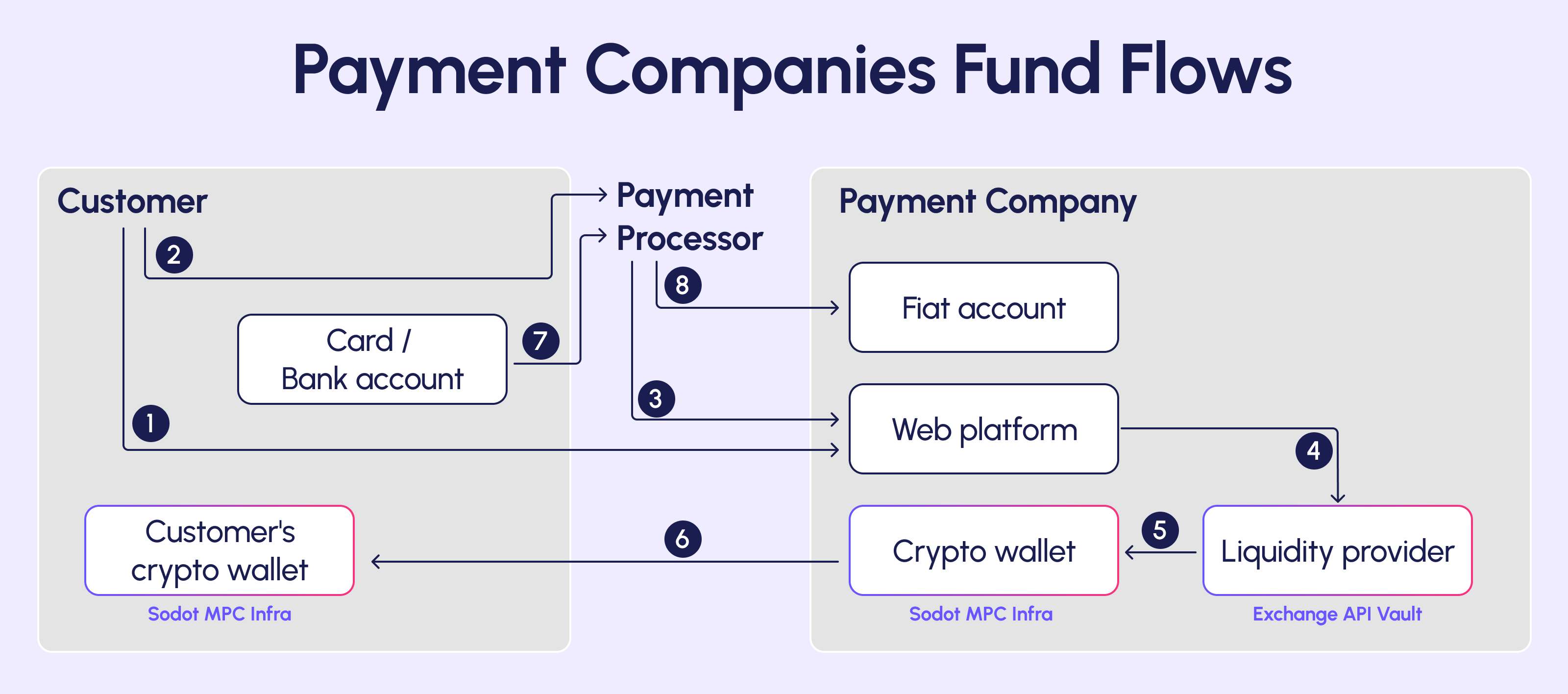
Payment companies process huge volumes. Self-hosted MPC allows you to optimize signing, set up multi-region deployments, customize thresholds, and integrate tightly with your existing rails. You get speed and consistency, close to zero latency without being limited by someone else’s infrastructure.
Lower cost as you grow
SaaS pricing scales with your success. Self-hosted infrastructure scales the way your other systems do. Over time, this becomes significantly more predictable and cost-effective for high-volume operations.
Digital asset payments are growing up
What used to be a “nice to have” wallet provider is now a foundational piece of regulated financial infrastructure. If uptime matters, if compliance matters, if resilience matters and if owning your stack matters, the industry is already showing where things are headed. Self-hosted MPC is becoming the new standard. Sodot makes this shift practical. More importantly, it gives teams confidence that their infrastructure is finally aligned with how they operate.
Want to hear more? Let’s talk.


