The digital asset industry has matured and with that maturity comes a new standard for infrastructure. For wallets, trading firms, payment platforms, custodians, and digital asset infrastructure providers, the challenge is no longer just protecting private keys. It is building systems that can support real operational complexity without introducing dependencies, bottlenecks, or blind spots.
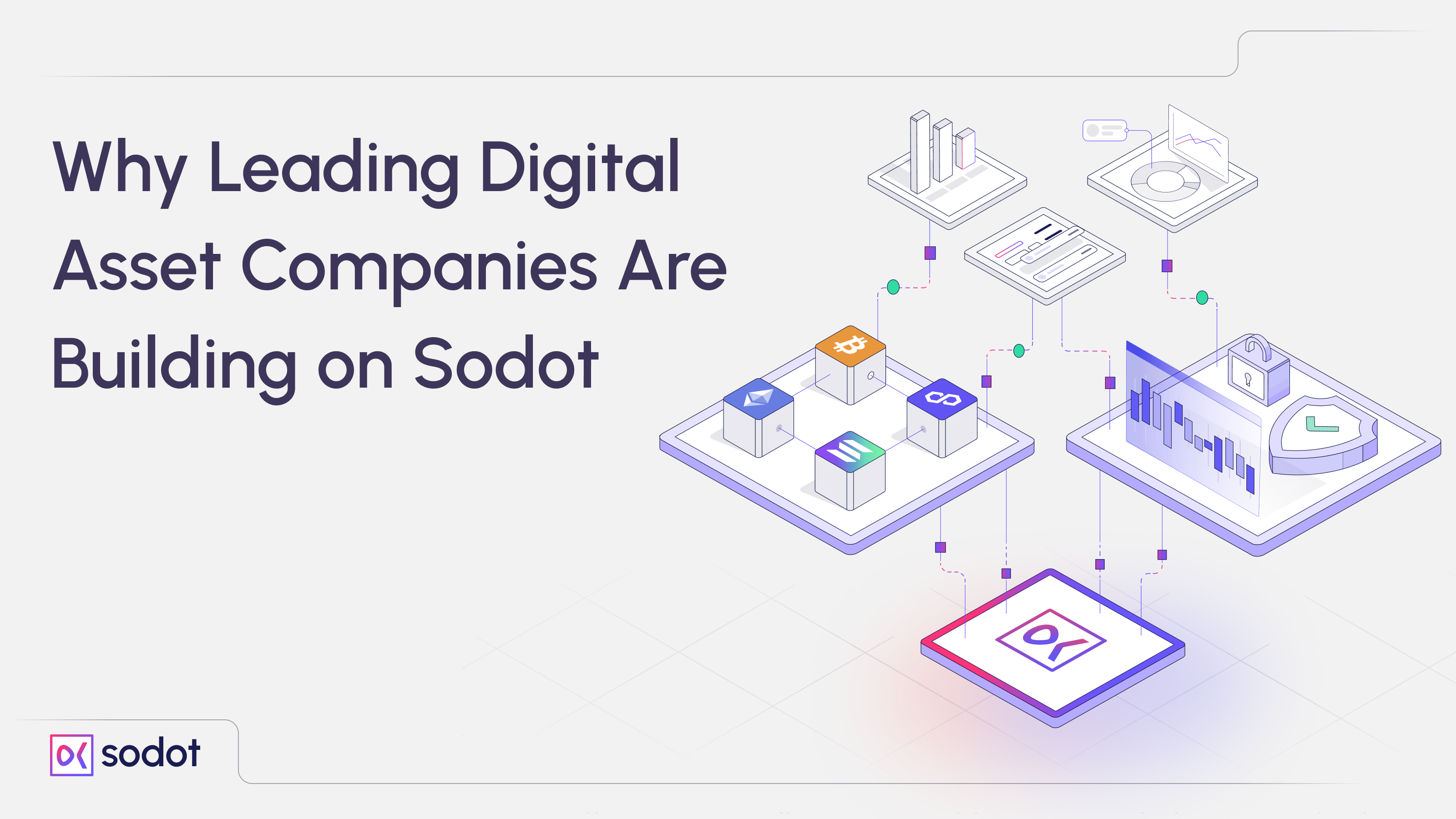
That is why leading companies across the ecosystem are building on Sodot. Trusted by market leaders including Exodus, MoonPay, eToro, Flow Traders, Raise, Bitcoin.com and others, Sodot has become the infrastructure layer of choice for teams that need to secure key operations while maintaining control, flexibility, and performance.
The New Challenge Is the Execution Layer
Security at the execution layer is becoming a defining infrastructure challenge for digital asset companies. Key management was always core. What has changed is the environment around it: the scale of operations, the number of systems involved, and the level of dependency many companies have accepted in order to move fast. Modern digital asset businesses now operate across wallets, trading systems, treasury workflows, payments, blockchain integrations, and internal automation. In that reality, the question is not simply how to secure keys. It is how to secure the systems that actually move capital, without introducing external dependency, operational bottlenecks, or architectural constraints.
Sodot was built for that reality. Its self-hosted MPC infrastructure is designed to eliminate full key exposure, enforce programmable policy controls, and secure execution across complex environments without dependencies or limitations. Just as importantly, it is purpose-built to help companies isolate their most sensitive key infrastructure and minimize vendor risk, something that is structurally difficult to achieve in SaaS models, where critical systems remain dependent on third-party environments by design. As attacks increasingly shift toward the execution layer, where credentials, services, and operational systems authorize value movement in real time, that level of control and separation becomes a core requirement for building securely at scale. Something that is structurally difficult to achieve in SaaS models, where critical systems remain dependent on third-party environments by design. As attacks increasingly shift toward the execution layer, that level of control and separation becomes a core requirement for building securely at scale.
Why Market Leaders Choose Sodot
1. Self-hosted architecture that gives teams real control
Leading digital asset companies do not want critical key infrastructure locked behind vendor-controlled environments. They want ownership of their product architecture, deployment model, governance, data, users, UX, and to remain within their security boundaries.
That demand is only becoming stronger. AI is accelerating both product cycles and competitive pressure, while also introducing new attack surfaces. In that environment, vendor dependency and product rigidity become harder to justify. Sodot’s self-hosted MPC infrastructure gives companies a way to secure sensitive key operations without dependencies or limitations. With distributed security, policy-driven control, and full operational ownership, teams can protect the systems that move capital while maintaining the flexibility to build around their own architecture.
2. Enterprise-grade security 2.0
Sodot is built around the principle that the most sensitive layer in digital asset infrastructure requires dedicated, purpose-built protection. Its architecture combines MPC, hardware-based security, and policy controls to reduce single points of compromise and govern how keys are used across complex environments.
For us, this is what enterprise security 2.0 looks like. The question is not only what controls exist, but who actually controls the environment. SaaS-based solutions can help companies go to market faster and ship products more quickly, but they also leave the most sensitive infrastructure dependent on someone else’s system. Sodot’s self-hosted model is built to minimize that dependency by isolating critical key infrastructure and giving companies direct control over the systems that move capital. That separation is harder to achieve, but it is exactly what modern digital asset companies need as they scale. True resilience comes not just from stronger security features, but from reducing vendor risk at the core.
3. Competitive advantage for real-world product builders
The strongest infrastructure does not just secure systems. It gives companies the ability to compete. In the digital asset sector, where competition is intense and AI is accelerating product cycles, user expectations, and even business model change, companies need more than a white-labeled solution they can launch quickly. They need control over the stack itself: the architecture, the user experience, the data, and the pace of iteration. Development timelines have compressed dramatically. Building is faster, adapting is faster, and shipping is faster. There is less reason to take shortcuts that create long-term dependency or limit differentiation.
This is where Sodot gives builders a real edge. SaaS-based products may reduce initial friction, but they also make companies vendor-dependent and often push them toward the same underlying product shape as everyone else. When you do not own the stack, it becomes harder to differentiate the product, evolve the user experience, adapt to market shifts, or build around your own strategic advantages. By contrast, owning the stack gives companies more control over how the product is built, how fast it evolves, and how effectively it responds to customers and market change. Sodot’s self-hosted infrastructure allows companies to secure critical key operations while retaining full ownership of their architecture, data, workflows, and product direction. Raise selected Sodot to strengthen key security across its blockchain-powered payments and loyalty ecosystem while preserving the flexibility to tailor deployments to its operational and compliance requirements. That combination of security, ownership, and adaptability is increasingly essential in a market where controlling the stack is not just a technical preference, but a competitive advantage.
4. Performance without compromising security
In digital asset infrastructure, performance is not just about speed. It is about scale, execution quality, and the ability to build products that can actually compete. This is especially true in trading environments, where systems must support automation, high throughput, and low-latency decision-making without weakening security.
The common tradeoff with SaaS is familiar: you can ship quickly, but you also inherit the limits of someone else’s architecture. That may help in the short term, but it can leave you vendor-dependent, slower to adapt, and ultimately building around constraints that are not your own. Sodot’s Exchange API Vault is designed to secure exchange API keys using enterprise-grade key security principles while remaining compatible with real-time trading and automated operations. Just as importantly, it gives companies the ability to own the stack behind performance-critical workflows, rather than becoming a wrapper around someone else’s product.
For firms like Flow Traders, this means modernizing trading key management infrastructure without sacrificing execution quality. Sodot’s platform is designed to support secure provisioning, management, monitoring, policy enforcement, runtime remediation, and real-time auditability for exchange-connected systems, while meeting the performance requirements of production trading environments. In categories where SaaS-based systems can introduce latency measured in seconds, Sodot’s architecture is designed for far more demanding environments, with sub-100 millisecond performance and support for approximately 250 microseconds in HFT-oriented workflows. That combination of security, scalability, and performance gives companies more than operational efficiency. It gives them control over the systems, data, and user experience that define competitive advantage.
A Common Pattern Across Different Market Segments
What is notable about the companies building on Sodot is not that they all look the same. It is that they do not, some are global consumer platforms, some are institutional infrastructure providers, some are trading firms, and some are building blockchain-powered payment and loyalty systems. What they share is the same infrastructure reality: they operate in high-stakes environments, need to move fast without exposing critical keys, and require systems that fit their architecture rather than forcing compromise. That is why the same core infrastructure principles continue to resonate across the market: self-hosted deployment, distributed signing, programmable policy enforcement, operational visibility, and the elimination of full key exposure.
Building for the Next Phase of Digital Asset Infrastructure
The digital asset stack is entering a new phase. The challenge is no longer just enabling access to crypto rails, but building infrastructure that institutions, platforms, and product teams can rely on as adoption scales. That requires stronger control over execution, better separation of risk, more flexible deployment models, and infrastructure that can match the complexity of modern operations.
This is where Sodot is focused. By enabling companies to secure the systems that actually move capital, Sodot helps them build market-leading products without limitations. That is why leading digital asset companies are building on Sodot.
Ready to explore Sodot?
If you are building digital asset products and need enterprise-grade key security without vendor dependency, Sodot gives you the infrastructure to move faster with more control.
Book a demo to see how leading digital asset companies are building on Sodot.